

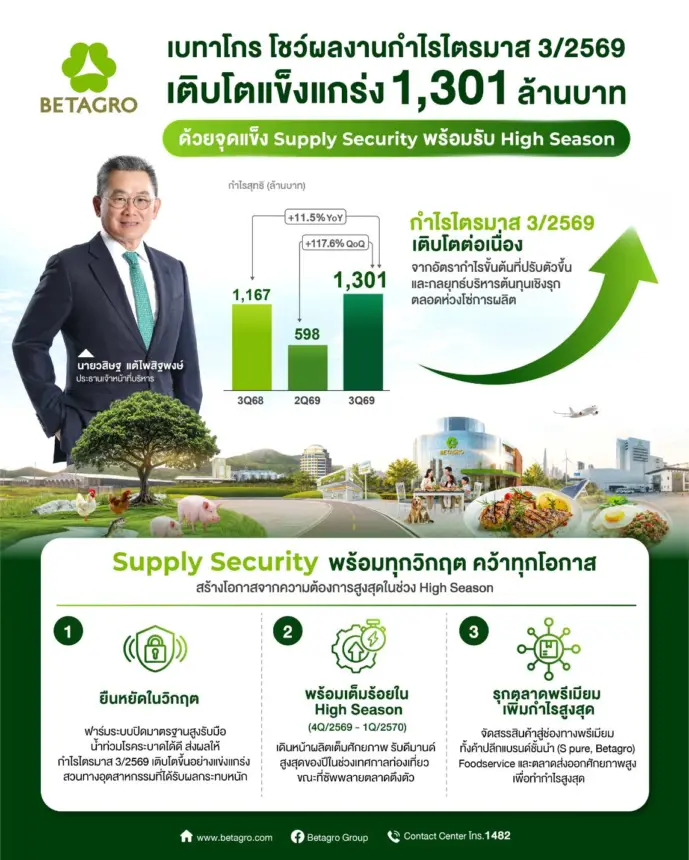
เบทาโกรกวาดกำไร Q3/69 โตแกร่ง 11.5% YoY ชูจุดแข็ง Supply Security พร้อมรับดีมานด์ไฮซีซั่น ยกระดับฟาร์มปลอดภัยสูง คุมต้นทุนเชิงรุก และเร่งขยายพอร์ตพรีเมียม
บริษัท เบทาโกร จำกัด (มหาชน) หรือ “BTG” บริษัทอาหารครบวงจรชั้นนำของไทย รายงานผลการดำเนินงานไตรมาส 3/2569 เติบโตอย่างแข็งแกร่ง ตอกย้ำความเป็นเลิศด้านการบริหารจัดการต้นทุนและห่วงโซ่อุปทานที่มั่นคง ควบคู่ไปกับการปรับพอร์ตสินค้ามูลค่าเพิ่มที่ตอบโจทย์ตลาดได้อย่างแม่นยำ สะท้อนขีดความสามารถในการแข่งขันและการสร้างผลตอบแทนที่ยั่งยืน
ในไตรมาส 3/2569 บริษัทฯ มีกำไรสุทธิ จำนวน 1,300.6 ล้านบาท เพิ่มขึ้น 11.5% เมื่อเทียบกับ 1,166.5 ล้านบาท ในช่วงเดียวกันของปีก่อน จากรายได้รวมเติบโต 7.5% แตะระดับ 33,061.7 ล้านบาท โดยได้รับปัจจัยหนุนสำคัญจากการยกระดับพอร์ตสินค้าสู่กลุ่มที่ทำกำไรสูงขึ้น การเพิ่มประสิทธิภาพการดำเนินงานอย่างต่อเนื่อง และการความคุมค่าใช้จ่ายในการขายและบริหารได้อย่างมีประสิทธิภาพ ส่งผลให้อัตราค่าใช้จ่ายในการขายและบริหารต่อยอดขาย อยู่ที่ระดับ 9.8% ลดลงจากปีก่อนที่ระดับ 10.5%
นายวสิษฐ แต้ไพสิฐพงษ์ ประธานเจ้าหน้าที่บริหาร บริษัท เบทาโกร จำกัด (มหาชน) กล่าวว่า “ผลการดำเนินงานที่โดดเด่นในไตรมาส 3 พิสูจน์ถึงความแข็งแกร่งของเบทาโกรในการก้าวข้ามความท้าทายของตลาด โดยสามารถผลิตและส่งมอบสินค้าสู่ตลาดได้อย่างต่อเนื่องแม้เผชิญวิกฤติอุทกภัย จากประสิทธิภาพการบริหารจัดการฟาร์มที่มีความปลอดภัยทางชีวภาพขั้นสูง การควบคุมต้นทุนตลอดห่วงโซ่อุปทานผ่านระบบอัตโนมัติ และการรุกตลาดพรีเมียมตามแผนงาน ทั้งหมดนี้จะเป็นแรงขับเคลื่อนสำคัญในการสร้างมูลค่าที่ยั่งยืนให้แก่ผู้ถือหุ้น”
เพื่อรองรับความต้องการสินค้าจากตลาดต่างประเทศที่ขยายตัวต่อเนื่องในช่วงไฮซีซั่น เบทาโกรได้ขยายกำลังการผลิตในโรงงานแปรรูปไก่ปรุงสุกเพื่อการส่งออกทั้ง 3 แห่ง ด้วยการเปิดไลน์การผลิตใหม่ และติดตั้งเครื่องจักรประสิทธิภาพสูง ส่งผลให้กำลังการผลิตในปี 2569 เพิ่มขึ้น 10% หรือประมาณ 15,000 ตันต่อปี และผลักดันกำลังการผลิตเพื่อการส่งออกรวมทั้งปีแตะระดับ 105,000 ตัน สอดรับกับคำสั่งซื้อช่วงปลายปีได้อย่างเต็มศักยภาพ
“เรากำลังเร่งผลักดันการส่งออกควบคู่กับการสร้างการรับรู้ของแบรนด์ในระดับสากล โดยปัจจุบัน เราได้รับคำสั่งซื้อล่วงหน้ายาวไปจนถึงสิ้นปี จากความต้องการที่แข็งแกร่งในตลาดหลักอย่างสหภาพยุโรป และญี่ปุ่น พร้อมก้นนี้ บริษัทฯ ยังคงรุกเปิดตลาดใหม่อย่างต่อเนื่อง เพื่อเพิ่มยอดขายและขับเคลื่อนการเติบโตของผลกำไรในระยะยาว” นายวสิษฐ กล่าวเพิ่มเติม
บริษัทฯ ให้ความสำคัญกับการปรับสมดุลพอร์ตธุรกิจ โดยมุ่งเน้นผลักดันกลุ่มผลิตภัณฑ์มูลค่าเพิ่มผ่านช่องทางจำหน่ายที่มีอัตรากำไรสูง ส่งผลให้ในไตรมาส 3 ปี 2569 ธุรกิจอาหารในประเทศไทยมีรายได้จากช่องทางสำคัญอย่างกลุ่มลูกค้า Foodservice เติบโตขึ้น 22.2% จากปีก่อน และโมเดิร์นเทรด เติบโตขึ้น 28.5% จากปีก่อน
นอกจากนี้ ยอดขายในตลาดต่างประเทศยังขยายตัวอย่างต่อเนื่อง โดยรายได้จากการส่งออกเติบโต 25.5% จากช่วงเดียวกันของปีก่อน โดยหลักมาจากผลิตภัณฑ์อาหารแปรรูปและอาหารพร้อมทาน อันเป็นผลสำเร็จจากการรุกขยายตลาดเชิงรุกในภูมิภาคที่มีศักยภาพสูง และการสร้างเครือข่ายพันธมิตรทางธุรกิจที่แข็งแกร่ง
จากผลการดำเนินงานที่แข็งแกร่ง เบทาโกรพร้อมต่อยอดสร้างคุณค่าแก่สังคมและสิ่งแวดล้อมอย่างเป็นรูปธรรม โดยภายหลังบรรลุเป้าหมายการลดก๊าซเรือนกระจก Scope 1 & 2 ได้สำเร็จ บริษัทฯ ได้เดินหน้าขับเคลื่อน Scope 3 ร่วมกับคู่ค้าตลอดห่วงโซ่อุปทาน โดยตั้งเป้าลดก๊าซเรือนกระจก 25% ภายในปี 2578 และมุ่งสู่ Net Zero ภายในปี 2593 เพื่อสร้างระบบนิเวศอาหารที่ยั่งยืนร่วมกัน
…….
Betagro Delivers Robust Q3 2026 Profit Growth of 11.5% YoY
Secures Peak-Season Supply, Powered by Biosecurity Standards, Disciplined Cost Controls, and Premium Portfolio Expansion
Bangkok – November, 11 2026 – Betagro Public Company Limited (BTG), a leading integrated food company in Thailand, reported strong third-quarter 2026 financial results, backed by effective cost controls, a resilient supply chain, and high-value product offerings. The solid performance reinforces the company’s market competitiveness and commitment to sustainable shareholder returns.
BTG posted a third-quarter 2026 net profit of 1,300.6 million baht, representing a 11.5% year-on-year increase from 1,166.5 million baht. Total revenue grew 7.5% to 33,061.7 million baht, on the back of higher-value product sales, and operational efficiencies. Notably, the SG&A-to-revenue ratio improved significantly to 9.8%, compared with 10.5% in the same quarter last year.
Vasit Taepaisitphongse, BTG’s Chief Executive Officer said, “Our performance this quarter highlights our capability to navigate the market headwinds and maintain supply continuity through recent flood challenges. Leveraging rigorous farm biosecurity, end-to-end supply chain automation, and premium product expansion, we remain firmly on track to create sustainable, long-term value for our shareholders.”
Capacity Expansion for Overseas Markets
BTG has expanded production capacity across three cooked chicken plants with new processing lines, and high-efficiency machinery to meet strong demand during the peak seasons. This expansion adds approximately 15,000 tons per year or up 10%, raising total annual production capacity to 105,000 tons in 2026.
“We are driving rapid export growth in parallel with increasing our brand awareness globally. We have secured strong purchase orders through year-end from key markets including the EU and Japan while continuing to penetrate new markets to support sustained revenue and profit growth,” Mr. Vasit added.
Portfolio Optimization: High-Value Products and Channels
In the third quarter of 2026, BTG continued to optimize its portfolio mix by expanding premium product sales across high-value channels. As a result, the company recorded year-on-year revenue growth of 22.2% in Foodservice and 28.5% in modern trade.
BTG also posted a 25.5% year-on-year increase in third-quarter 2026 export revenue, led by higher sales of processed and ready-to-eat items. The overseas momentum was bolstered by proactive expansion into high-potential markets and solid strategic partnerships.
Building a Sustainable Food Ecosystem on Strong Foundations
BTG’s strong operational foundation continues to accelerate its sustainability commitment. Following the successful delivery of Scope 1 and 2 emissions targets, the company is actively engaging supply chain partners to tackle Scope 3 emissions. BTG has set a target to cut greenhouse gas emissions by 25% by 2035, paving the way to achieve Net Zero emissions by 2050 while driving the collective growth of a sustainable food ecosystem.